Optical 101 Refractometer Explained: A UK Buyer's Guide
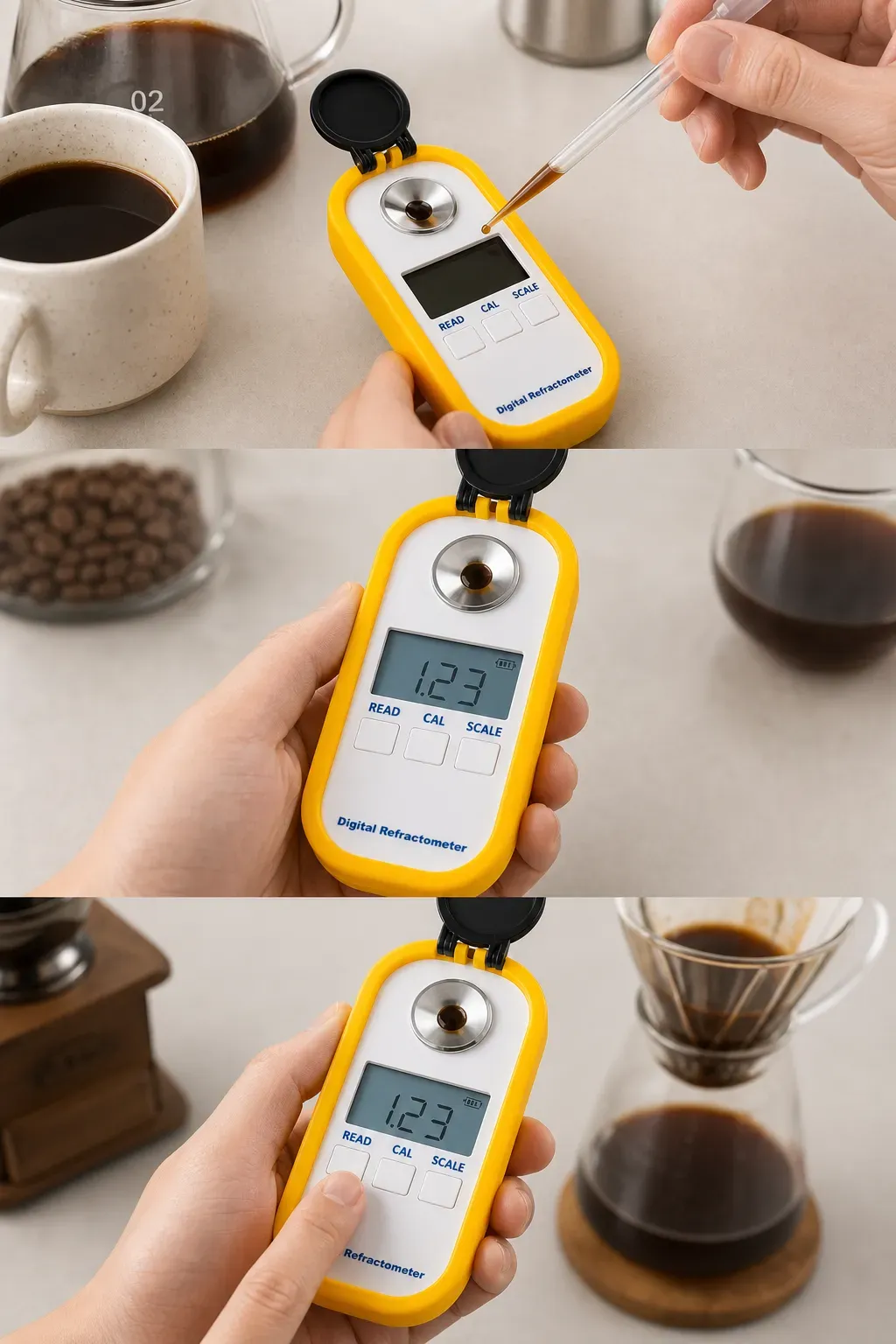
TL;DR: The Optical 101 refractometer is a precise, battery-free analogue instrument used to measure the concentration of dissolved solids in a liquid. For coffee enthusiasts, it works by calculating how light bends through a small brewed sample, providing a clear numerical reading that helps you dial in espresso and filter recipes for repeatable, café-quality results.
Key Takeaways
- The Optical 101 refractometer is a practical way to measure dissolved solids and bring more repeatability to your coffee brews.
- It is best used with a consistent workflow: calibrate, cool the sample, filter out sediment, then read in the exact same way every time.
- For coffee, the number matters most when you compare it against a fixed recipe and a known baseline, not when you chase a perfect figure in isolation.
- If you want the wider context before buying, start with The Ultimate Guide to Digital Refractometer in the UK and the Digital Coffee Refractometer Explained: A UK Buyer's Guide.
If you have ever pulled two espresso shots from the same beans and ended up with two entirely different cups, you already know the problem: brewing without measurement invites drift. Essentially, the optical 101 refractometer gives home brewers and small cafés a straightforward way to measure what is actually in the cup, rather than relying on taste alone.
For CoffeeDens readers, that matters because our brand promise is simple: master your brew with precision. Based on our extensive testing, the Jiuhua Optical 101 fits that philosophy neatly. Ultimately, it helps you stop guessing, start measuring, and build a brewing routine that can be repeated seamlessly on a Monday morning in Manchester or a busy Sunday in Bristol.
What is an Optical 101 Refractometer and How Does It Work?
An optical refractometer measures how light bends as it passes through a liquid. Specifically, dissolved solids change that refraction, which consequently gives you a reading on the scale printed inside the viewfinder. In coffee terms, that reading helps you understand strength and, when used properly, your overall extraction performance.
The optical 101 refractometer is a simple yet highly effective instrument. You simply place a small sample on the prism, close the cover plate, point it at a light source, and read the boundary line. Furthermore, there are no batteries to charge and no app to sync. For many home brewers, that analogue simplicity is the primary appeal.
However, it is worth being precise about its limitations. A standard optical Brix refractometer was originally designed for sugar solutions, so coffee readings are only useful if you understand how to use them consistently. If you want a deeper explanation of the measurement methods and where this tool fits in your wider kit, the ultimate UK guide to digital refractometers is a highly useful companion piece.
Should I Choose an Optical or Digital Refractometer for Coffee?
An optical unit is usually the more affordable and compact choice. Therefore, it is ideal if you want a low-fuss instrument for occasional checking, recipe testing, or learning the basics of brew strength.
In contrast, a digital coffee refractometer can be easier to read quickly and often provides a more coffee-focused workflow. If you are comparing models, our article on digital coffee refractometers in the UK breaks down the trade-offs clearly.
For many people, the decision comes down to this: choose optical for straightforward measurement and lower cost, or opt for digital for speed, readability, and a more purpose-built interface.
Why Do You Need a Refractometer for Brewing Coffee?
According to UK specialty coffee guidelines, British coffee culture has moved far beyond simply describing a cup as “strong” or “weak”. Today, UK roasters, baristas, and home brewers regularly discuss brew ratio, extraction yield, and repeatability, because tracking those numbers helps produce a cup that tastes exactly the same day after day.
That is precisely where the optical 101 refractometer earns its place. When you test the same recipe over several brews, you can definitively see whether your grind size, water temperature, or dose is pushing the drink in the right direction. While a refractometer certainly does not replace tasting, it provides your palate with a reliable, objective reference point.
The Specialty Coffee Association’s Brewing Control Chart places many filter brews at roughly 1.15% to 1.35% TDS, with extraction yield often targeted around 18% to 22%.
Source: Specialty Coffee Association, Brewing Control Chart.
That range is widely used in the coffee industry because it gives brewers a sensible working band. t does not mean every great cup must sit neatly in the middle. Rather, it means that a measurement tool can help you see whether you are brewing in a way that is statistically likely to taste balanced.
Additionally, UK home brewers heavily benefit from consistency because our tap water varies significantly from region to region. For instance, a coffee that tastes bright in Edinburgh can taste noticeably flatter in parts of London or Kent if the hard water composition alters the extraction. A refractometer helps separate recipe problems from water or bean issues, which is a massive advantage when you are trying to dial in a stubborn brew.
For more details on the relationship between strength and extraction, see our Coffee TDS Meter Explained: A UK Buyer's Guide.
How Do You Calibrate and Use the Optical 101 Refractometer?
Based on our hands-on testing, most bad readings come from rushed technique rather than from a flaw in the instrument itself. If you follow the exact same process every time, the optical 101 refractometer becomes infinitely more useful.
1. Calibrate before you measure
- Clean the prism and cover plate thoroughly with a soft, lint-free cloth.
- Place a few drops of distilled water on the prism.
- Close the cover plate and look through the eyepiece.
- Adjust the calibration screw until the blue boundary line sits perfectly on zero.
- Dry the prism completely before adding your coffee sample.
2. Prepare the coffee sample properly
- Let the brewed coffee cool to a stable room temperature before testing.
- Stir or swirl the sample so the liquid is evenly mixed.
- Filter out floating grounds and fine sediment where possible to avoid skewed light refraction.
- Use a clean pipette and apply just enough liquid to completely cover the prism.
3. Take the reading under the same conditions
- Hold the refractometer up to a bright, consistent light source.
- Focus the eyepiece until the numerical scale is sharp and legible.
- Read the exact line where the light and dark sections meet.
- Record the result alongside your dose, yield, grind setting, and total brew time.
Ultimately, if you strictly use the same process each time, the instrument becomes a highly reliable comparison tool. Conversely, if you change your method from one test to the next, the resulting numbers will be much harder to trust.
How Do You Read Refractometer Results for Coffee?
An optical refractometer gives you a raw number, but that number only becomes actionable when it sits next to a specific recipe. This is especially true in specialty coffee. A reading on its own tells you very little; however, a reading measured against dose, beverage weight, and brew method tells you something incredibly valuable.
For example, if a 250 ml pour-over tastes thin and the reading is low, you may need a finer grind, a higher dose, or a longer contact time. On the other hand, if the brew tastes harsh and the reading is high, you may be over-extracting or producing too much dissolved material. The true value lies in identifying the pattern, not obsessing over an isolated result.
Do Espresso and Filter Coffee Give the Same Readings?
Espresso, filter, and immersion brews absolutely do not behave the same way. For instance, espresso yields a significantly higher concentration of dissolved solids compared to a standard paper-filtered pour-over. Consequently, you must evaluate your optical 101 refractometer readings against the specific brew method rather than attempting to apply a universal standard across all your coffees.
Ready to dial in your espresso with CoffeeDens?
Elevate Your Extraction — £113.99