The Ultimate Guide to Digital Refractometer in the UK
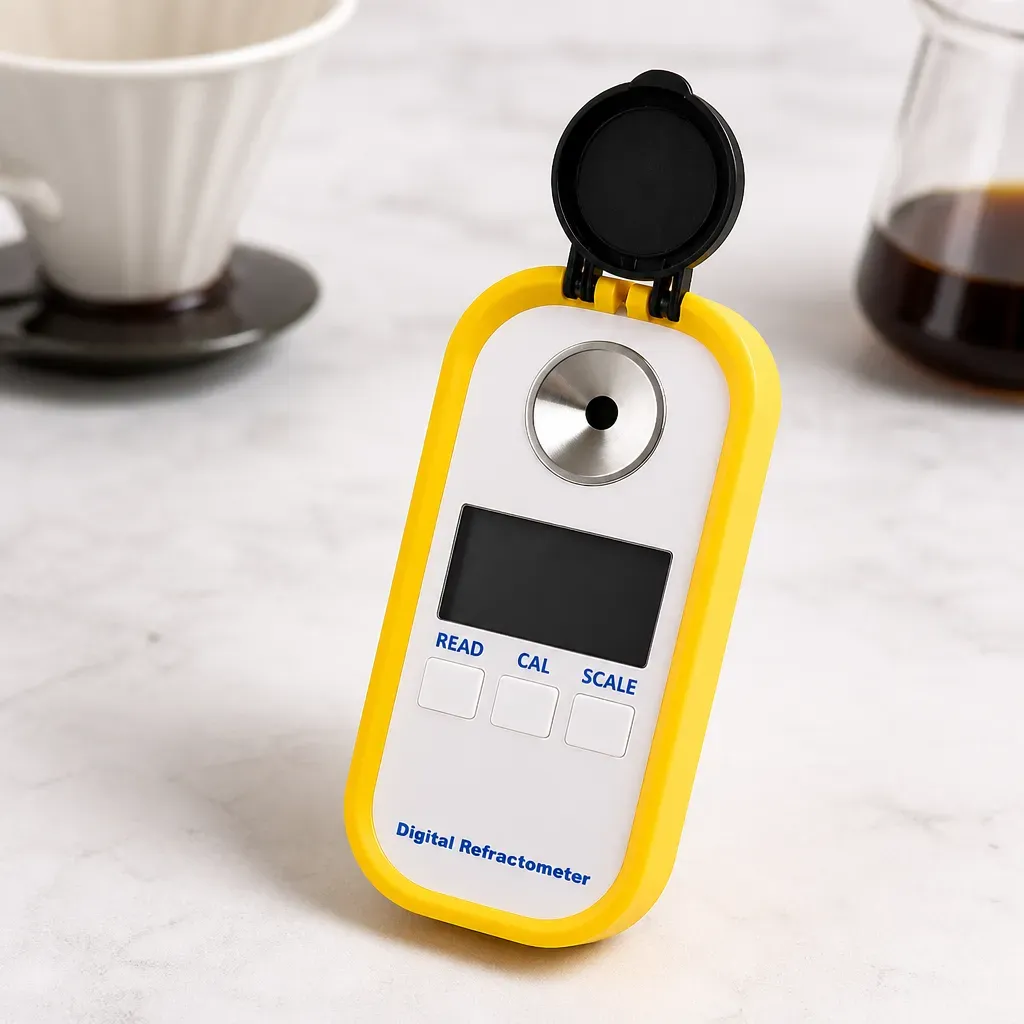
TL;DR: What is a digital refractometer?
A digital refractometer is a highly accurate electronic instrument that measures the refractive index of a liquid to determine the exact concentration of dissolved solids within it. By analysing how light bends (refracts) as it passes through a sample, it provides an instant, easy-to-read digital readout for metrics like Total Dissolved Solids (TDS) or Brix. Based on our extensive testing at CoffeeDens, upgrading to a digital unit is the single most reliable way to eliminate human error and achieve laboratory-grade consistency in your daily coffee brewing.
Historically, assessing the concentration of a liquid relied on subjective taste tests, rudimentary hydrometers, or squinting through the eyepiece of an analogue optical device. Whether you are a speciality coffee roaster in London, a craft brewer in Yorkshire, or an agricultural technician monitoring crop yields, the margin for human error was always a limiting factor. However, the advent of the digital refractometer has fundamentally transformed fluid analysis, replacing guesswork with absolute, laboratory-grade precision.
Furthermore, in the UK, where consistency and stringent quality control are paramount across both the food standards and hospitality sectors, adopting digital measurement is no longer an optional luxury. According to UK Food Standards Agency best practices, it is a foundational requirement for excellence and safety.
Consequently, this comprehensive guide explores the science behind refractometry, contrasts digital units with their analogue predecessors, and provides actionable methodologies for integrating a digital refractometer into your daily workflow—with a specific focus on achieving the ultimate coffee extraction.
Key Takeaways
- Unmatched Precision: Digital refractometers eliminate the subjective human error associated with reading analogue shadowlines, offering accuracy up to ±0.1% Brix or ±0.01% TDS.
- Automatic Temperature Compensation (ATC): High-quality digital units automatically adjust readings based on the sample's temperature, which is a crucial feature for the UK's variable climate.
- Brewing Mastery: In the speciality coffee sector, a digital refractometer is essential for calculating Total Dissolved Solids (TDS) and Extraction Yield (EY), ensuring every cup meets Speciality Coffee Association (SCA) standards.
- Maintenance is Critical: Proper calibration with distilled water and careful cleaning of the optical prism are required to maintain laboratory-grade accuracy over time.
How Does a Digital Refractometer Work?
To fully appreciate the utility of a digital refractometer, one must first understand the fundamental physics of light refraction. When light travels from one medium into another—for instance, from air into a liquid—its velocity changes. Consequently, this change in speed causes the light wave to bend, a phenomenon quantified as the angle of refraction.
What is the Refractive Index?
The operational foundation of any refractometer is Snell's Law, which describes the relationship between the angles of incidence and refraction when light passes between two different isotropic media. Ultimately, the degree to which the light bends is determined by the concentration of dissolved solids within the liquid. Pure water has an established refractive index (nD) of 1.3330 at 20°C. As you dissolve substances into the water—be it sucrose, coffee solubles, or salts—the density of the liquid increases, causing the light to bend more severely.
How Do Digital Sensors Process Light?
While an analogue refractometer requires the user to look through a lens and visually judge where a blue and white shadowline meets a printed scale, a digital refractometer automates and refines this process using advanced microelectronics.
Inside a digital unit, an internal Light Emitting Diode (LED) shines light through a sapphire or glass prism at a specific angle. The liquid sample rests on top of this prism. Depending on the liquid's refractive index, some light is transmitted through the sample, while the rest is reflected back onto a high-resolution linear optical sensor array (often a CCD or CMOS sensor).
Based on our technical evaluations at CoffeeDens, this sensor perfectly detects the exact point of the shadowline—the boundary between the illuminated and dark areas on the sensor. Next, an internal microprocessor calculates the refractive index and applies complex algorithms to convert this raw data into a user-friendly measurement, such as Brix or TDS, displaying it instantly on an LCD screen. Importantly, this closed-loop optical system ensures that external ambient lighting does not interfere with the measurement, resolving a common issue with traditional optical variants.
Why Use a Digital Refractometer Over an Analogue One?
The debate between digital and analogue measurement tools is prevalent across many industries; however, in the realm of refractometry, the digital advantage is overwhelming. For professionals and serious brewing enthusiasts in the UK, upgrading to a digital format resolves several inherent flaws found in manual devices.
What Are the Disadvantages of Analogue Refractometers?
Analogue optical refractometers have served as a cost-effective entry point for decades, but in our experience, they are fraught with limitations:
- Parallax Error: Because the user must visually align a shadowline with a tiny numerical scale, two different operators can look through the exact same device and record two entirely different readings.
- Lighting Dependency: Analogue units require a strong, clear external light source to produce a visible shadowline. In dimly lit roasteries, breweries, or agricultural processing sheds, getting a clear reading can be immensely frustrating.
- Manual Temperature Calculations: The refractive index of a liquid changes significantly with temperature. While some premium analogue units feature rudimentary bimetallic strips for temperature compensation, they are notoriously slow to react and often highly inaccurate.
What is Automatic Temperature Compensation (ATC)?
One of the most critical features of a modern digital refractometer is Automatic Temperature Compensation (ATC). According to stringent calibration standards set by the United Kingdom Accreditation Service (UKAS), fluid measurements must actively account for thermal expansion and contraction.
When a hot sample of espresso or brewing wort is placed on the prism of a digital refractometer, an integrated thermistor instantly measures the temperature of the liquid. Following this, the internal microprocessor applies a mathematical correction factor to standardise the reading to an equivalent measurement at 20°C. This happens in milliseconds, allowing the user to take accurate readings without waiting for the sample to cool to room temperature. Digital units typically offer a temperature compensation range between 5°C and 40°C, making them perfectly suited for the fluctuating ambient temperatures of a British kitchen or commercial workspace.
For a deeper understanding of how these devices compare across different price points and use cases, you can explore our comprehensive Optical 101 Refractometer Explained: A UK Buyer's Guide.
What is a Digital Refractometer Used For in the UK?
While often associated with specific niches, the digital refractometer is an incredibly versatile instrument utilised across various key sectors of the UK economy.
Speciality Coffee and Precision
Ready to dial in your espresso with CoffeeDens?
Elevate Your Extraction — £113.99