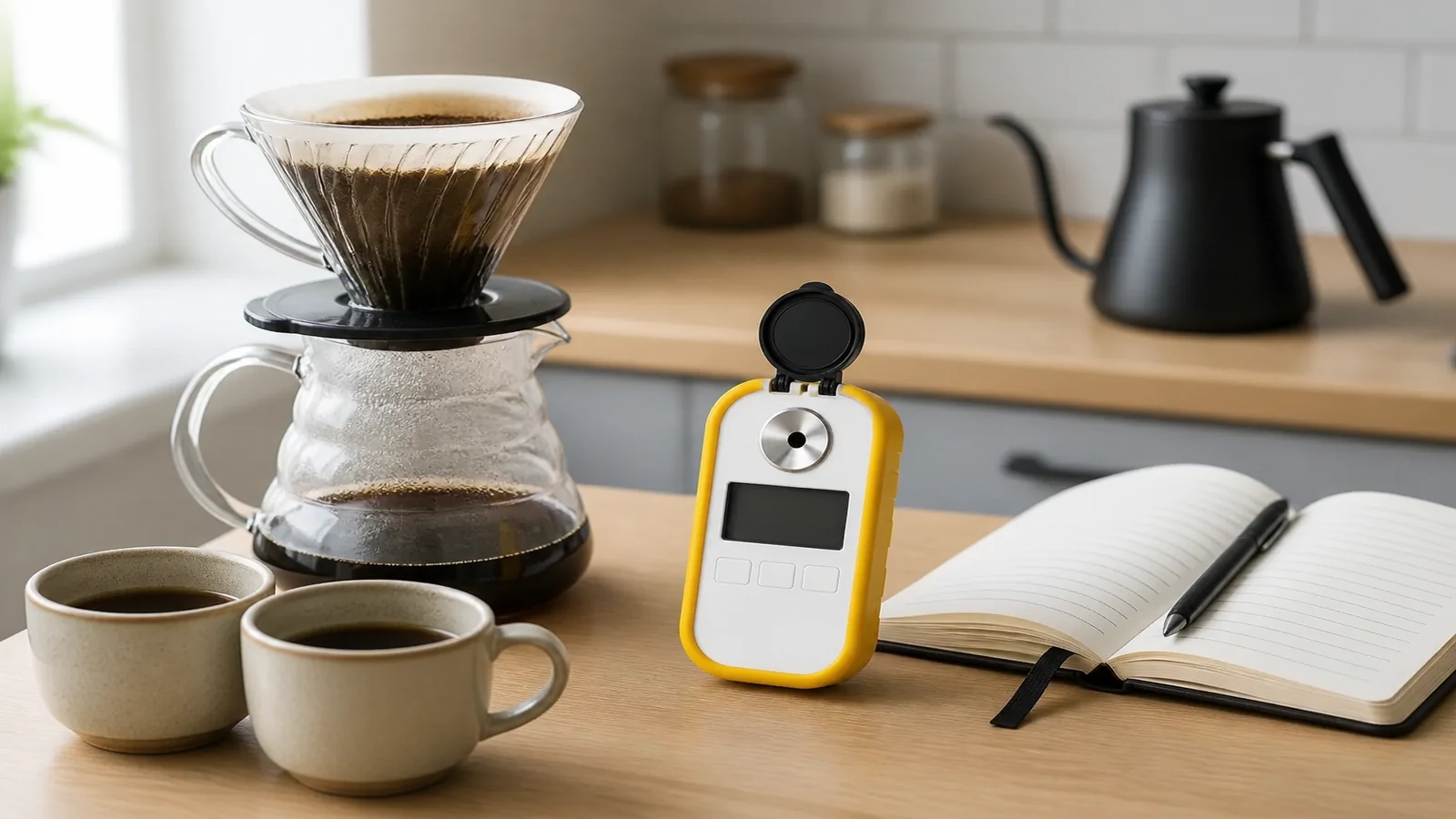
Why pour over tastes different same recipe UK: what moves between cups
If your pour over tastes different every morning despite the same recipe, the problem is rarely “bad luck”. UK home brewers usually see cup-to-cup drift because one invisible variable moved while everything written in the notebook stayed the same. Grind size shifts after the first few days in the bag, kettle temperature drops between pours, or agitation changes when you rush the bloom. Without a number on the cup, sourness and thinness feel identical even though they need opposite fixes.
Same notebook, different cup: what actually moves
Start by separating what you control from what you only think you control. Dose, water weight and timing can look identical while particle size distribution changes as burrs warm or beans degas. Water chemistry from a Brita jug also shifts over a fortnight as the cartridge ages. A Tuesday cup that tastes bright and a Thursday cup that tastes flat can share the same 15 g to 250 g ratio yet land in different strength bands.
Strength versus extraction: two variables in one sip
Filter coffee typically sits around 1.15% to 1.45% TDS with extraction yield near 18% to 22%, according to commonly cited SCA-style guidance quoted on the CoffeeDens product page. Strength tells you how much dissolved coffee is in the cup; extraction tells you how much you pulled from the grounds. A weak, sour cup is often under-extracted at low strength, while a thin but sharp cup can be under-extracted at acceptable strength. Guessing from taste alone collapses those paths.
Hidden shifts grind, water and agitation cause
Grind drift is the usual suspect when the recipe is “unchanged” but the grinder dial was never locked. Even half a notch on a hand grinder changes surface area enough to move TDS by a few hundredths of a percent. Pour height, swirl intensity and filter paper rinse also alter flow rate. If you always rinse the V60 paper but skip it once, the first drawdown can run fast and produce a different cup without any parameter looking wrong on paper.
Log one number per brew before you change gear
Before replacing beans or buying a new kettle, log dose, yield, brew time and one TDS reading for three consecutive brews with the same bag. Stir the sample, let hot coffee cool briefly, then place a few drops on a digital refractometer zeroed with distilled water. If TDS swings more than about 0.05 percentage points while taste swings wildly, your process stability—not the coffee—is the variable to fix first.
When a refractometer helps and when it does not
A refractometer does not replace tasting; it stops you from “fixing” strength when extraction is the issue. It also will not compensate for stale beans, dirty equipment or water you never tested. Treat it as a repeatability tool for the recipe you already trust on good days.
Review the Optical 101 if you want repeatable numbers
If you want a UK-listed digital refractometer with a published 0–50 range, automatic temperature compensation and an IP65 rinse-friendly sample well, review the current price and specifications on the Jiuhua Optical 101 detail page. It displays coffee TDS so you can compare Tuesday’s cup with Thursday’s using the same objective scale.
Can taste alone tell strength from extraction?
Not reliably. Both under-extraction and low strength can taste sour or thin, which is why many brewers chase the wrong adjustment.
How many brews should I log before changing grind?
At least three consecutive sessions with the same beans, noting TDS each time, usually reveals whether drift is procedural or recipe-related.
Does a refractometer fix inconsistent recipes automatically?
No. It shows whether the cup changed in strength or extraction so your next adjustment targets the right variable.