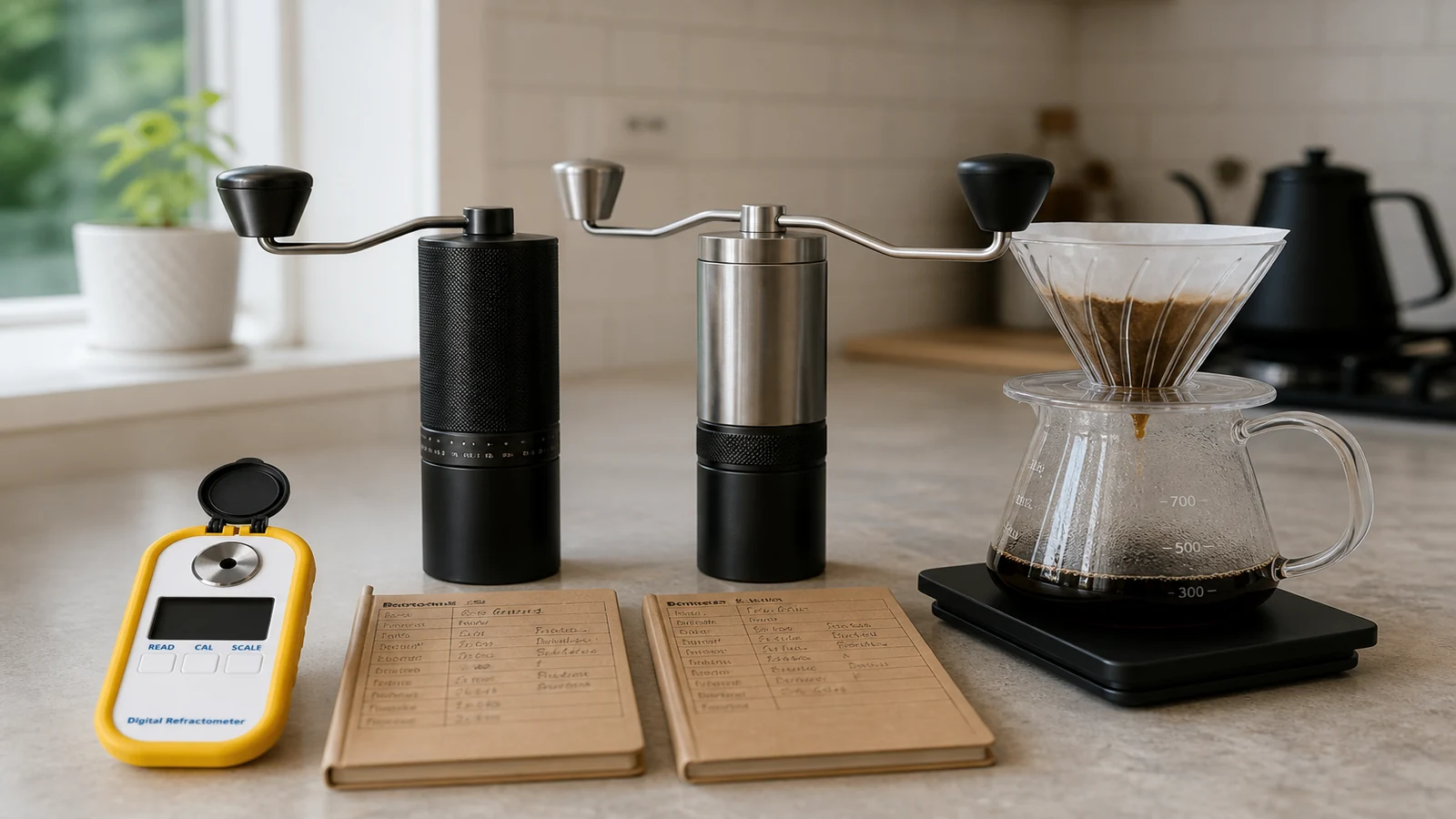
Grinder upgrade ab test coffee extraction data: prove it before you buy
Forum posts claim a new grinder “unlocked sweetness overnight”. Without extraction data, you cannot tell whether burrs changed particle distribution, whether you subconsciously changed pour technique, or whether fresh burrs simply made you grind finer. A simple A/B test with TDS logs turns a pricey upgrade into an evidence-based decision—especially for UK home brewers chasing V60 repeatability on a single daily bag.
Why upgrade stories need numbers
Grinder swaps alter fines production, peak extraction speed and clarity at the same nominal setting. Taste memory is biased toward novelty. Logging TDS, extraction yield and drawdown time for matched brews shows whether clarity gains come from higher evenness or from a stronger, slower shot you would have reached on the old burrs with one notch finer.
Baseline a week on your current grinder
Before spending, run your current recipe for at least five sessions: fixed dose, water, kettle, filter paper and agitation script. Record TDS and calculated extraction each time. Note the spread. If you already swing 0.10% TDS day to day, a grinder upgrade will not fix procedural noise—you need a stable baseline first.
Controlled A/B protocol on one bag
Use one bag of the same roast, rested equally. Day A: current grinder at your verified setting. Day B: new grinder adjusted to match drawdown time within five seconds—not match setting numbers, which are not comparable across brands. Brew duplicate cups back-to-back when possible, cooling samples before refractometer readings. Change only the grinder between pairs.
Which metrics move when burrs improve
Look for tighter TDS clusters at the same taste score, higher extraction before bitterness appears, or shorter drawdown at the same extraction (more even grinding). A single heroic cup is not proof; three matched pairs with smaller variance is.
When data says keep the old grinder
If medians overlap and only one brew tasted “better”, save your money and fix technique. If the new grinder requires much finer settings to hit the same time, check whether you are comparing worn burrs to fresh ones—replacement burrs on the same body can mimic an upgrade.
Measure with a repeatable refractometer workflow
Zero with distilled water, stir samples, and log coffee TDS from a device with automatic temperature compensation. The Jiuhua Optical 101 on CoffeeDens publishes a 0–50 range with coffee TDS display and an IP65 rinse-friendly well—practical for back-to-back morning tests. Review live specs before ordering; the protocol works with any consistent meter.
How many paired brews are enough?
Three pairs on one bag usually reveal variance changes; five pairs are better if your baseline spread is wide.
Should I match grind setting numbers?
No. Match drawdown time and target extraction, then compare taste at matched yield.
Can TDS alone prove grinder quality?
Pair TDS with extraction yield and taste notes; one number without ratio context misleads.