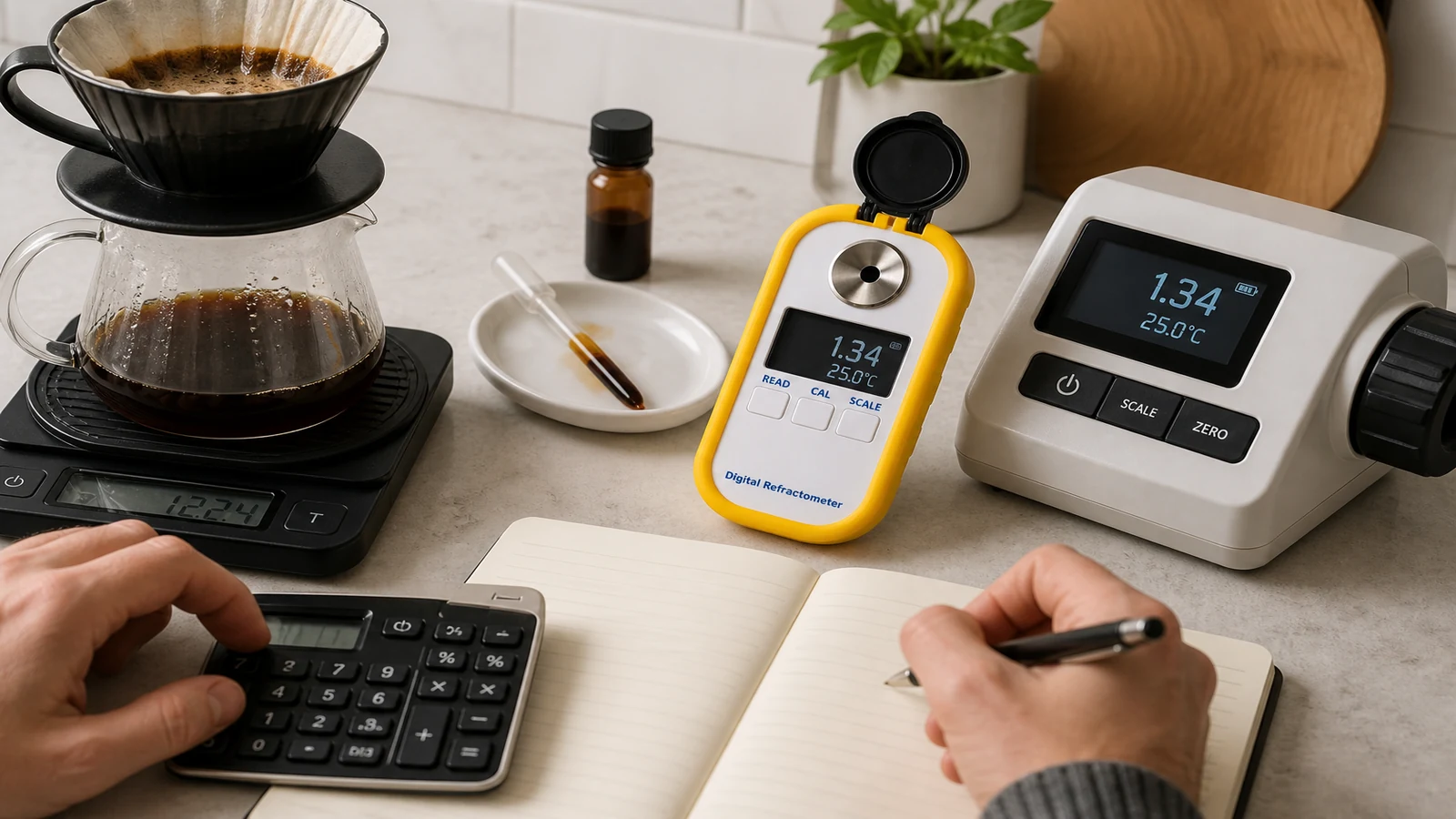
Coffee extraction yield calculator pour over: UK workbook without an app
Extraction yield tells you what percentage of the dry coffee ended up dissolved in the cup. For pour over, UK brewers use it to answer a practical question: was yesterday’s sweet V60 actually extracted differently, or did you simply brew a stronger cup? You only need TDS from a refractometer, your dose and your beverage weight—no subscription calculator required.
What extraction yield measures in a V60 cup
Yield is not the same as strength. A 1.35% TDS reading can come from a 1:15 brew or a 1:17 brew; the ratio changes how much coffee you pulled from the grounds even when strength looks similar. Specialty coffee guidance commonly targets 18% to 22% extraction for filter coffee. Outside that band, cups often taste sour and thin (under) or bitter and drying (over) regardless of how “strong” they feel.
The formula without a paid app
Use this standard approximation: extraction yield (%) = (TDS × beverage weight) ÷ (dose × (100 − TDS)) × 100. Measure TDS as a percentage—1.35 means 1.35, not 0.0135. Weigh dose and final cup in grams. Example: 15 g dose, 250 g cup, 1.32% TDS gives roughly 20.1% yield. Spreadsheet the same inputs if you prefer; the maths fits a phone notes app.
Worked example with realistic UK kitchen numbers
Imagine a weekday V60: 15.0 g medium roast, 250 g out, 2:45 drawdown, TDS 1.28%. Plugging in yields about 19.4%—inside the usual filter window but toward the lower edge, which often tastes gently sour if your water is soft. Nudging grind finer without measuring might push strength up while leaving yield short. Measuring before the tweak shows whether you need more extraction or simply more coffee in the cup.
Reading the brewing control chart bands
Think of strength (TDS) on one axis and extraction on the other. Moving ratio at fixed grind shifts both; changing grind at fixed ratio mainly moves extraction. Logging two numbers per brew prevents the common mistake of grinding finer to fix sourness when the real issue is low strength at acceptable extraction.
Logging yields across a bag of beans
Keep a simple table: date, dose, yield weight, time, TDS, calculated extraction, taste note. After six brews you will see whether your “standard recipe” actually spans a 0.08% TDS band. That spread explains inconsistent cups more honestly than blaming the roaster.
Pair the maths with a TDS-capable refractometer
The Jiuhua Optical 101 on CoffeeDens displays coffee TDS across a published 0–50 range with automatic temperature compensation—useful when you are calculating yield at the kitchen counter rather than in a lab. Confirm the live price and specs before you order; the tool does the measuring, you still choose the target band.
Do I need an app to calculate yield?
No. A calculator or spreadsheet with dose, cup weight and TDS is enough for home pour-over work.
What TDS should I aim for in filter coffee?
On-site guidance cites roughly 1.15% to 1.45% TDS for filter coffee, alongside 18%–22% extraction yield targets.
Can I use Brix readings directly in the formula?
Use coffee TDS mode if your device offers it. Raw Brix needs conversion before yield maths.