Brix vs TDS coffee refractometer explained for UK brewers
Searching “brix vs tds coffee refractometer explained” usually means you are staring at a 0–50 digital readout and wondering which number belongs in your notebook. Brix and coffee TDS are related but not interchangeable. Using the wrong scale—or applying a generic sucrose conversion to coffee—silently breaks extraction yield maths and sends your grind adjustments in the wrong direction.
Two scales on one 0–50 window
Many handheld digital refractometers share a wide 0–50 numeric range because the optics can measure refractive index across sweet liquids, not because filter coffee ever approaches 50. Filter brews typically land below 2 on whichever coffee-calibrated scale you use, while espresso concentrates sit higher but still far below the top of the scale. The useful part of the range is a narrow band; the headline number is not the whole story.
What Brix actually measures in the cup
Brix historically expresses dissolved sucrose equivalents. Coffee contains acids, lipids and melanoidins—not table sugar—so a Brix reading is an approximation unless the device applies a coffee-specific conversion curve. That is why two machines with the same 0–50 badge can disagree on the same sample.
Why coffee TDS is the brewer-facing number
Total dissolved solids (TDS) for coffee is the metric used in extraction yield formulas and in most UK specialty brewing guides. When a refractometer offers a dedicated coffee TDS mode, use it for dial-in and logging. Treat raw Brix as a legacy or multi-use scale for syrups and fermentation projects, not as a drop-in substitute for coffee TDS without verifying conversion.
Conversion mistakes that ruin dial-in
Common errors include logging Brix while calculating yield with a TDS formula, mixing readings from different temperature compensation settings, and comparing your kitchen device with a lab unit that uses another curve. Always zero with distilled water, stir samples, and let hot coffee cool briefly even when automatic temperature compensation is enabled—rapid evaporation on the prism still skews repeatability.
Which scale to log in your brewing notebook
Pick one scale per bag of beans and stick to it. Note device model, mode, dose, beverage weight and calculated extraction alongside the raw reading. If you switch modes mid-bag, previous rows become apples-to-oranges comparisons.
Check how the Optical 101 labels its display
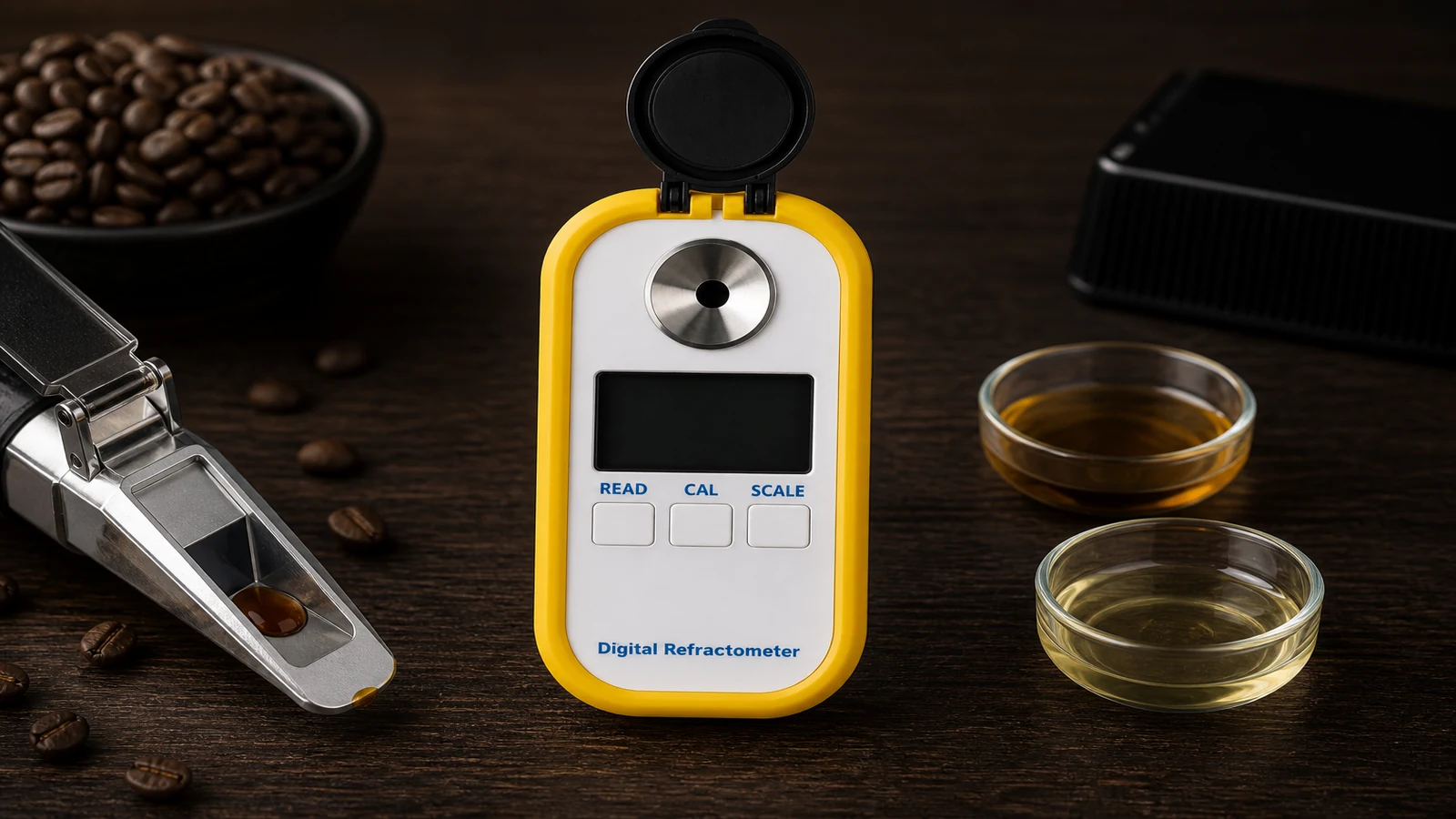
The CoffeeDens listing for the Jiuhua Optical 101 states that the unit can display both Brix (0–50 range) and coffee TDS—confirm the on-screen mode before you log numbers. Published specs also list automatic temperature compensation and an IP65 rinse-friendly sample well for busy morning workflows.
Can I use Brix in extraction yield formulas?
Only if you convert to coffee TDS using a trusted curve. Logging coffee TDS directly avoids that error.
Why do filter readings look tiny on a 0–50 scale?
Filter coffee strength is a small fraction of the instrument’s full range; most of the scale headroom is for other liquids.
Does a wider range mean better for coffee?
Not automatically. Resolution and repeatability in the 1.0%–2.0% band matter more than the maximum number on the badge.